There is a particular kind of person who owns forty-one varieties of loose leaf tea and brews all of them in the same chipped mug using a tea ball shaped like a tiny house. I’m not here to judge that person. I’m here to gently suggest that they deserve better, and so does their countertop.
Building a tea station in a small kitchen is a genuinely different problem from building one in a large kitchen. In a large kitchen you can simply acquire things. A dedicated tea cabinet. A wall of tins. A samovar, if the mood strikes. In a small kitchen, every object has to justify its existence in writing, and half of them are still going to get evicted by the toaster.
So this is a short list. Eight pieces, all compact, all built well enough that you won’t be quietly replacing them in eighteen months. Nothing here is novelty tea gear. Nothing here is a mug with a lid shaped like a cat. These are the pieces that make a tiny kitchen tea corner feel intentional rather than improvised.
1. The Kettle That Also Steeps, So You Only Buy One Thing
Breville BTM500CLR Tea Maker Compact Infuser and Water Kettle, 4 Cup
The single biggest space win in a small-kitchen tea setup is refusing to own a kettle and a brewing vessel. This one does both. It boils water, it holds five temperature presets for green, white, oolong, herbal and black, and it has a variable steep timer from one to five minutes that beeps at you when your tea is done — which is more accountability than most of us get from our friends.
At 34 ounces it’s genuinely small, which is the entire point. The full-size Breville tea makers are magnificent objects that will also swallow roughly a quarter of your usable counter. This one is sized for a person, not a tea room.
The stainless steel basket is dishwasher safe, which matters more than you’d think when the alternative is picking wet leaves out of mesh at 7am.
2. A Teapot You’d Actually Leave Out
If your teapot lives in a cupboard, you will not use it. This is not a moral failing, it’s just physics — the effort of retrieval exceeds the appeal of tea roughly 80% of the time. The fix is owning a teapot attractive enough to live on the counter permanently.
Hario ChaCha Kyusu “Maru” Tea Pot, 300ml
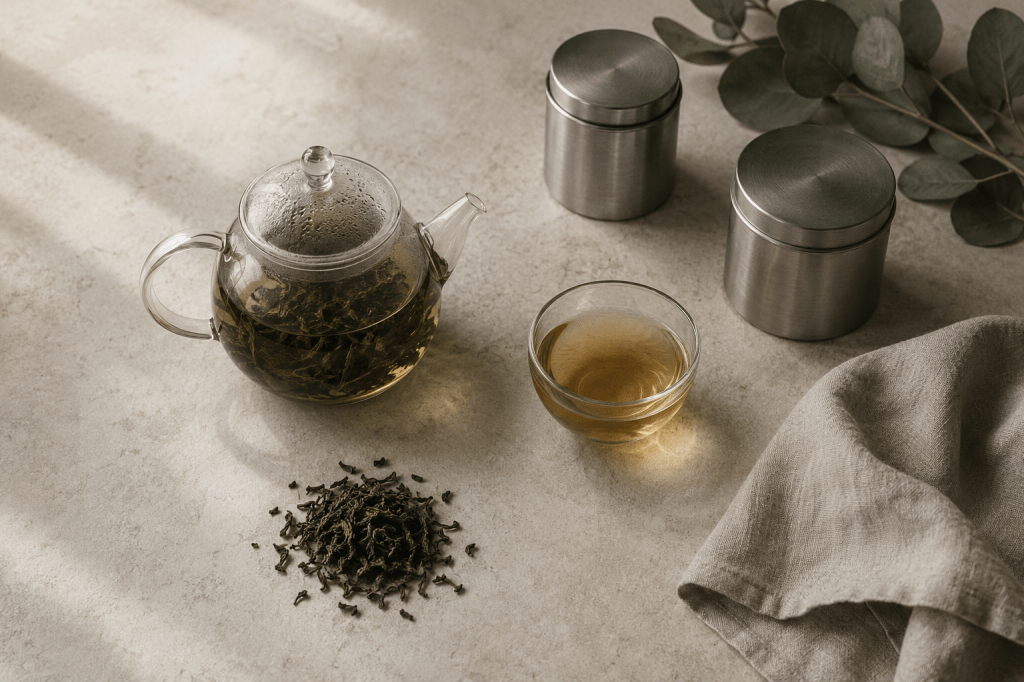
Hario has been making heatproof glass in Japan since 1921, and the Maru is their most quietly perfect object. Rounded, low-profile, with a generously wide stainless strainer that lets leaves actually unfurl instead of compressing them into a sad wet brick. The 300ml is the small one, which is what you want — it’s a two-cup pot, not a dinner-party pot.
It’s also microwave safe once the strainer’s out, and being able to see the colour develop as it steeps is a small daily pleasure that never really wears off.
KINTO UNITEA One Touch Teapot, 450ml
If you’d rather have fewer parts to wash, the UNITEA takes a different approach: the strainer is built into the lid, so there’s no basket to lift out and nowhere for leaves to hide. Three components, all dishwasher safe, done.
KINTO has been designing tableware in Shiga since 1972 and it shows in the handle — a wide arch that’s genuinely comfortable to hold, which sounds like a small thing until you’ve used a teapot with a bad one. It also doubles as a V60 carafe if you’re already coffee-equipped.
3. For When You Want Exactly One Cup
Finum Brewing Basket, Medium
Some days a teapot is a commitment you’re not prepared to make. The Finum basket is the answer: micro-fine stainless mesh in a heat-tolerant frame, sized to drop straight into a mug, with enough volume that large-leaf oolongs and whites can expand properly instead of steeping in a tea-ball-shaped prison.
The detail that elevates it above every other infuser is the lid. It keeps the heat in while you steep, then flips over and becomes a drip tray for the spent basket — so you’re not walking a dripping mesh cup across your kitchen to the bin. Made in Hamburg, dishwasher safe, and costs roughly the same as two coffees.
Buy two. They’re small and they disappear.
4. Drink It Out of Something Decent
KINTO UNITEA Cup, 350ml
Heat-resistant glass, microwave and dishwasher safe, and part of the same UNITEA line, so it stacks visually with the teapot instead of fighting it. Clear glass is also, practically speaking, the correct choice for tea — you spent money on leaves that produce a specific colour, and drinking them out of opaque stoneware means you never see it.
At 350ml it’s a proper cup rather than a thimble, and the plain cylindrical shape means it doubles for cold brew, iced tea, or anything else you need a glass for. In a small kitchen, an object that does two jobs is worth two objects.
5. The Matcha Situation
Jade Leaf Matcha Traditional Starter Set
Matcha is having a decade. Unfortunately most of the resulting equipment is sold in enormous gift boxes containing a ceramic bowl the size of a birdbath, a whisk stand, a bamboo scoop rest, and a certificate of some kind.
This set is the sensible version: a bamboo chasen, a chashaku scoop, a stainless steel sifter, and a printed guide. That’s the actual working kit — the sifter in particular is the step everyone skips and then wonders why their matcha is lumpy. No bowl included, which is a feature, because you almost certainly already own something wide enough and it saves you the shelf space.
The chasen is a consumable, incidentally. Plan on replacing it every three to six months with daily use, the same way you’d replace a good pepper mill’s teeth or a knife’s edge.
6. Storage That Isn’t a Drawer Full of Crumpled Foil
KINTO LT Canister, 250ml
Loose leaf tea has three enemies: light, air, and being stored in the bag it came in with a clothespin on it. The LT canister handles all three via a double-lid structure in 18/8 stainless steel with a hairline finish — meaning it’s genuinely airtight and also looks like an object rather than a container.
The 250ml holds a sensible amount of a single tea, which is the right unit. Buy three, line them up, and you have a tea station instead of a tea pile. They’re small enough to sit on a narrow shelf and handsome enough that you’ll want them visible.
Worth noting these are frequently stocked by Japanese import sellers, so availability moves around. If it’s out, the 450ml runs on the same design.
7. Cold Brew Tea, Fridge-Door Edition
Hario Mizudashi Cold Brew Tea Pot, 1000ml, Smokey Green
Cold brewing tea is one of the highest-return, lowest-effort things you can do — dramatically sweeter and less astringent than anything you get from hot brewing, and it requires no skill whatsoever. Add roughly 15g of leaves, fill with water, refrigerate for three to six hours, drink.
The reason this specific carafe belongs in a small kitchen is the shape: it’s tall and narrow, deliberately sized to fit in a refrigerator door, which is the one piece of storage nobody competes for. The mesh filter sits in the lid so you pour straight from the pot, and the mouth is wide enough to get a hand inside for cleaning, which is a spec more manufacturers should take seriously.
Hario heatproof glass, made in Japan, smoky green so it doesn’t look like laboratory equipment.
The Actual Point
You don’t need all eight. You need the kettle, one brewing vessel, and somewhere decent to put the leaves — that’s a complete tea station and it occupies about the footprint of a cutting board.
The rest is expansion, and expansion should be earned. If you’re drinking matcha twice a week, get the whisk. If summer is coming, get the cold brew carafe. What you shouldn’t do is buy a fourteen-piece “tea lover’s gift set,” discover you use two pieces of it, and spend the next four years storing the other twelve because throwing away a gift feels rude.
Small kitchen, high standards. The square footage was never the constraint — the discipline was.
This post contains affiliate links. If you buy something through them, I earn a small commission at no extra cost to you. It funds more tea, which funds more posts about tea, which is a closed loop I’m quite comfortable with.


Leave a Reply