Let’s get the controversial part out of the way first: yes, you can buy a cutting board for $9.99. It will also warp, stain, and start smelling faintly of every onion you’ve ever chopped on it within a month. It will also, eventually, end up on the sidewalk with a “FREE” sign taped to it, quietly judging you from the curb.
Meanwhile, the $200 version will outlive your lease, your relationship status, and possibly several of your houseplants.
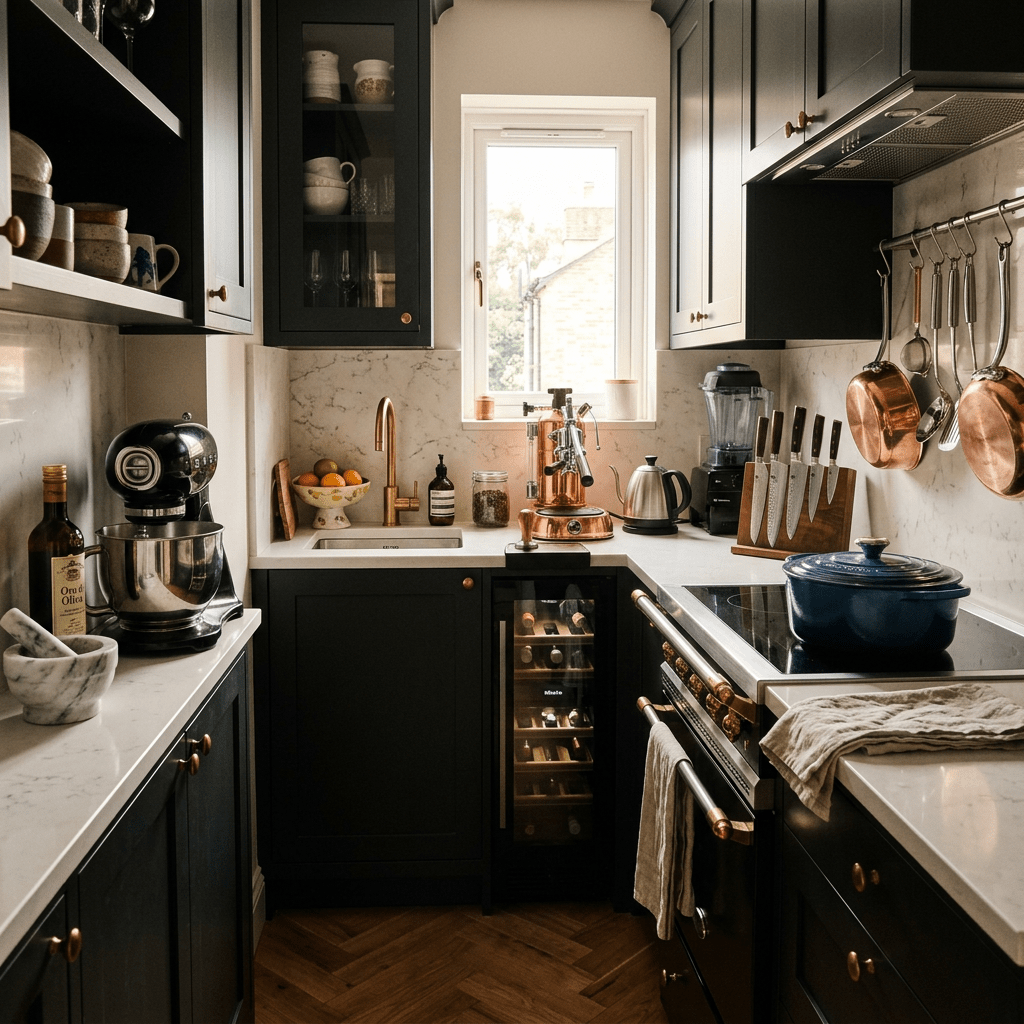
This is the thesis of small-kitchen living that nobody wants to hear: when you have less space, every single item is doing more work. That flimsy bargain-bin board isn’t just cutting your vegetables — it’s occupying real estate you don’t have to spare, in a kitchen where every square inch is already fighting for its life. A small kitchen doesn’t have room for mediocrity. It only has room for things that are good.
So let’s talk about small-kitchen blasphemies: the expensive, unnecessary, slightly indulgent kitchen tools that are actually the opposite of wasteful, because you’ll only ever need to buy them once.
Exhibit A: The Cutting Board You’ll Never Replace
An end-grain teak or walnut cutting board — the kind made of little wood blocks standing on their ends like a tiny lumber skyline — isn’t just prettier than your current board. It’s self-healing. The knife slides between the wood fibers instead of slicing through them, so the surface closes back up instead of scarring. Twenty years from now, this board will still be flat, still be beautiful, and still be doing its job, while you’ve thrown out four plastic ones in the meantime.
Look for a proper end-grain board from a brand that’s been doing this for decades, like John Boos — their blocks are practically a rite of passage for anyone who has started to suspect they might actually enjoy cooking.
If counter space is truly nonexistent, a smaller Proteak end-grain board gives you the same durability in a footprint that won’t eat your entire counter.
Exhibit B: A Knife That Isn’t Secretly a Butter Knife
Here’s an uncomfortable truth: most of what makes cooking in a small kitchen feel stressful isn’t the lack of space. It’s using dull, cheap knives that require twice the effort and produce twice the mess. A single well-made chef’s knife will outperform an entire twelve-piece knife block you didn’t ask for and don’t have room to store anyway. Wüsthof is the classic, reliable choice — the kind of knife that makes you feel vaguely more competent just holding it.
Prefer something a little lighter and sharper out of the box? A Mac Knife chef’s knife is a favorite among people who take their onions seriously.
One knife. Sharpened properly. That’s the whole system. Deeply unglamorous, extremely effective.
Exhibit C: A Digital Scale That Looks Like It Has a Job Interview
If you’re meal prepping in a small kitchen, you already know that “eyeballing it” leads to seventeen slightly different portion sizes and a Tupperware drawer full of chaos. A proper kitchen scale — sleek, minimal — takes up less space than a stack of mail and makes portioning genuinely effortless. The Escali Primo is a small-kitchen cult favorite for a reason.
If you’d rather match your stainless appliances, an OXO digital scale is just as precise and slightly more understated.
It will not, however, help you eyeball whether that’s really a “serving size” of pasta. Some blasphemies are self-inflicted.
Exhibit D: Mixing Bowls You Wouldn’t Be Embarrassed to Serve From
Nesting stainless steel or ceramic mixing bowl sets — the kind with lids, the kind that stack like they were engineered by someone who has personally suffered through a cabinet avalanche — solve two problems at once: prep and storage. A stainless set from Cuisinart is practically indestructible and disappears neatly into any cabinet.
For something that goes straight from mixing to fridge to table without an unflattering plastic detour, a ceramic set from Le Creuset does double duty as serveware.
The Actual Point
None of this is about spending money for the sake of it. It’s about recognizing that in a small kitchen, cheap tools cost you twice: once at checkout, and again every single day you have to store, replace, and tolerate them. A handful of genuinely good pieces — a board, a knife, a scale, a bowl set — will take up less total space than a drawer full of stuff you bought because it was $6 and seemed fine at the time.
Buy less. Buy better. Let your kitchen counter breathe.
This post contains Amazon affiliate links. If you make a purchase through one of these links, I may earn a small commission at no additional cost to you.


Leave a Reply